Murray Clark
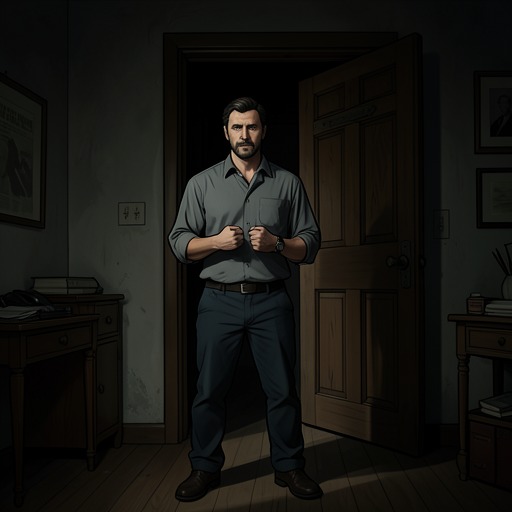
American RustMurray Clark is a potential eyewitness to the death of Otto Carson, and his recognition of Billy Poe turns an unresolved killing into a case that may be tried in court. The narrative gives him little independent history or speech, but his presence changes the choices facing Poe, Lee English, and Bud Harris. First treated as a witness whose credibility might be challenged, Murray becomes the person Harris threatens and then kills to protect Poe.
Identity and Place in the Case
Murray enters the case through a message from the district attorney: investigators have found someone who says he was present when the murder occurred. The witness cannot initially name the football player he saw, but is confident he would recognize him in a lineup. Harris understands that the identification could connect Poe to the scene, and checks Murray’s record. It lists driving-under-the-influence arrests in 1981 and 1983, followed by a disorderly-conduct arrest in 1987, with nothing since. Harris considers that Murray may have turned his life around; the old arrests, he realizes, are not enough to discredit him in court.
Murray’s importance rests on recognition rather than on a detailed account of the killing. Poe remembers that Murray had recognized him from the football team during a chance encounter. Poe also fears that Murray’s memory of the encounter, combined with the fight between them, will make an identification more likely and give Murray a reason to retaliate. That fear shapes Poe’s response to the possibility of trial: the witness is not an abstract legal obstacle but someone who knows his face and has already been in conflict with him.
Testimony and Its Consequences
The account of the events at the plant reaches the reader through the case against Poe. In one version put to him, Isaac English leaves when he sees a fight developing, while Poe remains and strikes the witness; Otto Carson is then struck more severely and dies. This is an accusation presented during questioning, not a complete independent account of Murray’s testimony. It nonetheless establishes why Murray matters: his presence could place Poe in the confrontation and help distinguish Poe’s actions from Isaac’s departure.
The witness’s appearance also changes how other characters understand the danger of speaking. When Poe tells Lee English what happened, Lee starts thinking in terms of lawyers and opposing sides: Isaac and her father on one side, Poe on the other. The possibility that Murray can identify Poe makes silence more than an informal act of loyalty; it carries legal consequences for several people. Harris, meanwhile, first tries to persuade Poe to explain the plant incident so that a jury might hear a claim of self-defense. He warns that a jury seeing only a killing followed by flight could convict him. The warning acknowledges that Murray’s testimony may be part of a prosecution that Poe cannot simply outwait.
Protection, Threat, and Death
The district attorney arranges a payment of one hundred dollars a week for Murray under the name of witness protection. Harris recognizes that the money may keep Murray in the area, but that it offers no actual protection. He considers whether Murray might be persuaded to leave, then understands that intervening would mean trading his own safety for Poe’s. His decision is not presented as a routine investigative judgment: it grows from his commitment to protect Poe and his willingness to place himself in jeopardy for that purpose.
Harris locates the house where he believes Murray is staying and watches it through the night. Around three in the morning, two men enter. Harris thinks one is Murray, but the presence of another man complicates his plan; he considers waiting until Murray is alone and knows Murray might leave or return for the trial. When Harris addresses him by name, he threatens that anyone who reports seeing him will be in danger, and specifically warns him against speaking further to the district attorney in Uniontown, Pennsylvania. The threat makes Harris’s objective plain: he wants Murray to stop cooperating with the prosecution.
Murray does not remain where Harris can control him. In the darkness, Harris sees him moving through nearby brush and shoots him twice. Murray dies, and Harris’s hands shake as he tries to put away his gun. The killing removes the witness who could identify Poe, but it also makes Harris responsible for a second death and exposes him to the consequences he had feared. The witness-protection payment has failed to secure Murray’s safety; Harris’s attempt to prevent testimony ends in murder rather than in Murray’s departure.
Narrative Significance
Murray is a limited but decisive character: the story does not develop him through an extended personal history, yet gives his testimony enough weight to redirect the choices of those around him. His record offers Harris a possible line of attack, but not a reliable way to defeat his evidence. His recognition of Poe is more consequential than his past arrests, while his willingness to stay near the area is shaped by the money he receives and the approaching trial.
His fate exposes the difference between protection as an official label and protection as a lived reality. The state’s weekly payment keeps Murray available as a witness without shielding him from Harris. At the same time, Harris’s conduct shows how a private promise of loyalty can become a decision to interfere with the law and take a life. Murray’s death therefore does not settle the story’s conflict; it deepens it, replacing the threat of testimony with the consequences of silencing the witness.